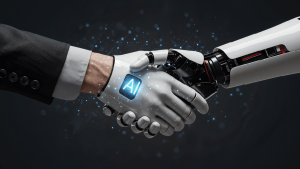
Human–AI Strategist: The Next Critical Role Every Future-Ready Enterprise Needs
Stay updated with us
Sign up for our newsletter

Artificial Intelligence has moved from experimentation to enterprise-wide adoption. Yet many organizations still struggle to translate AI promise into predictable business value. The gap isn’t technology—it’s strategy.
Enter the Human–AI Strategist, a new-age role designed to orchestrate collaboration between people, machines, and processes. Positioned at the intersection of HR, IT, L&D, and business leadership, this role ensures AI is deployed ethically, responsibly, and in direct alignment with organizational outcomes.
As AI becomes the backbone of talent development, productivity, workforce planning, and customer value, enterprises are realizing that they need more than technical experts. They need bridge-builders—leaders who can translate human potential into AI-powered capability at scale.
Why Organizations Need a Human–AI Strategist Today
1. AI Adoption Is Outpacing Workforce Readiness
Organizations are onboarding AI tools faster than employees can upskill. A Human–AI Strategist ensures that:
- teams are prepared for AI workflows,
- job roles evolve with automation,
- learning paths map to real competency needs.
They design continuous upskilling frameworks so AI becomes an enabler—not a threat.
2. HR and IT Need a Converged AI Roadmap
AI impacts recruitment, performance, employee experience, cybersecurity, and compliance. Traditionally, these domains operate in silos.
Read More: Transforming Employee Benefits with AI: Smarter, Faster, and More Personalized Experiences
A Human–AI Strategist aligns HR, IT, and business units by:
- defining unified AI governance,
- selecting the right AI tools,
- ensuring data, talent, and technology work together.
This convergence drives cost savings, reduces redundancy, and accelerates implementation.
3. AI Success Depends on Human-Centered Deployment
Many AI projects fail not because of technology, but because employees don’t understand how to use it.
A Human–AI Strategist focuses on:
- employee adoption and change management,
- designing user-friendly AI use cases,
- ensuring psychological safety and trust.
This human-first approach transforms AI from a complex system into a practical everyday companion.
Key Responsibilities of a Human–AI Strategist
1. AI Capability Mapping
They assess how AI impacts every job role, department, and skill cluster. This involves:
- workforce capability audits,
- future-skills forecasting,
- identifying high-impact automation opportunities.
The objective is to maintain a continuously evolving talent blueprint.
2. Designing Skill-First Learning Ecosystems
The strategist builds learning frameworks where AI supports employee growth:
- AI-driven personalized learning paths
- competency-based assessments
- role-specific upskilling journeys
This ensures training investments connect directly to business outcomes.
3. Building Responsible AI Governance
Trust drives adoption. Human–AI Strategists shape ethical guardrails by:
- monitoring bias and data privacy risks,
- establishing explainability and human oversight protocols,
- ensuring compliance with evolving AI regulations.
They protect the organization from both cultural and legal risks.
4. Creating High-Value AI Use Cases
Instead of experimenting blindly, they design use cases aligned with financial and operational KPIs such as:
- productivity uplift
- reduced operational costs
- shorter time-to-hire
- improved decision accuracy
This creates measurable ROI from AI.
5. Driving AI Change Management
They lead:
- leadership alignment conversations,
- communication strategies,
- employee readiness programs,
- stakeholder education.
Without structured change management, even the best AI tools fail.
What Skills Make a Great Human–AI Strategist?
1. Hybrid Expertise: Tech + People
The strategist must understand both the capabilities of AI and human behavior. They are translators between algorithms and people.
2. Data Fluency
Not necessarily data scientists, but comfortable with:
- data patterns,
- analytics dashboards,
- AI decision systems.
They use insights—not intuition—to guide strategy.
3. Workforce Transformation Knowledge
They understand:
- job redesign
- future workforce planning
- digital adoption metrics
- employee learning sciences
This makes them invaluable partners to CHROs and CIOs.
4. Ethical and Responsible AI Mindset
They ensure AI enhances fairness, transparency, and employee well-being.
5. Excellent Communication and Storytelling
They explain complex AI systems in simple, actionable terms for business leaders and frontline teams.
Read More: AI Assistants for Recruiters: Transforming Hiring Efficiency and Experience in 2025
Where Does the Human–AI Strategist Fit in the Organizational Structure?
The role usually sits strategically between:
- CHRO → for talent and workforce transformation
- CIO / CTO → for technology implementation
- CLO or L&D Head → for capability building
- COO → for operational excellence
In many modern enterprises, it acts as a cross-functional leader driving AI transformation end-to-end.
Impact of a Human–AI Strategist on Business Outcomes
1. Accelerated AI ROI
With structured prioritization and roadmapping, organizations see faster returns.
2. Reduced Skill Gaps
Continuous upskilling ensures employees stay future-ready.
3. Higher AI Adoption Rates
Employees embrace AI when it feels supportive—not disruptive.
4. Stronger Employer Brand
Companies that invest in human-centered digital transformation attract top talent.
5. Ethical and Compliant AI Ecosystems
They prevent misuse, ensure auditability, and build trust internally and externally.
The Future Outlook: A Must-Have Role by 2030
By 2030:
- Almost 40% of job responsibilities will be augmented by AI.
- Enterprises will require leaders skilled in AI-human orchestration—not just technical AI building.
- HRTech and WorkTech platforms will embed AI deeply into processes like hiring, L&D, employee engagement, and retention.
The Human–AI Strategist will become as essential as today’s Chief Digital Officer—bridging human capability and intelligent technology to drive sustainable transformation.
Organizations that adopt this role early will build agile, skill-first, high-performance workforces capable of competing in an AI-driven economy.