Backend Engineer Interview Prep 2026: Top FAANG Questions for Backend Roles
For many software engineers, back-end interview preparation has long been treated as a numbers game: solve enough algorithm problems, memorize a few system-design templates, and rely on repetition to carry them through. While this approach can still work in some cases, it has become increasingly unreliable in FAANG+ interviews. Interviewers evaluate more than correctness. They assess how candidates’ reason under constraints, communicate trade-offs, and apply engineering judgment in real time.
In practice, most experienced engineers do not struggle because they lack technical ability. They struggle because their preparation is unstructured and difficult to evaluate. Without a clear framework, candidates often gravitate toward familiar problem types, avoid weaker areas, and lack objective signals indicating whether their performance is improving. Progress feels busy, but not measurable.
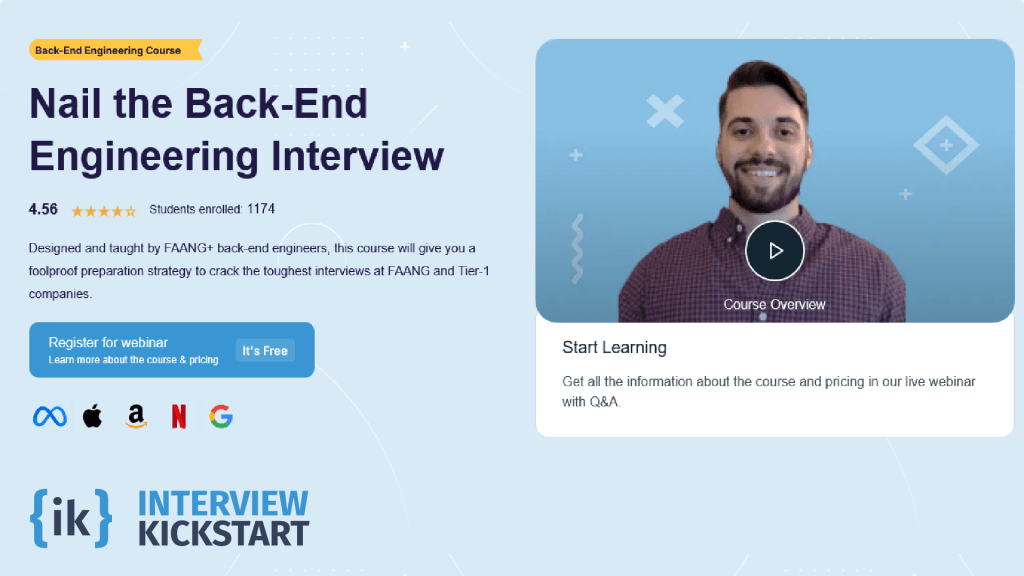
Interview Kickstart’s Back-End Engineering Interview Course was developed to address this gap by treating interview preparation as an engineering problem in itself. The program applies structure, performance tracking, and feedback loops to turn preparation into a repeatable process rather than a collection of ad-hoc activities.
The course is designed and taught by FAANG+ back-end engineers who have direct experience both clearing interviews and conducting them at large technology companies and high-growth startups. Their perspective shapes how the curriculum is structured. Rather than focusing only on problem completion, the program trains candidates to demonstrate the behaviors interviewers consistently look for: structured thinking, clear communication, the ability to reason about trade-offs, and adaptability when requirements change mid-discussion.
Catch more HRTech Pulse Insights: The Future of Behavioral Intelligence: How Enterprises Will Decode Human Signals at Scale
These skills have become decisive factors in modern hiring loops. Interviewers are increasingly less interested in whether a candidate reaches a perfect solution and more interested in how they approach ambiguity, recover from missteps, and explain their thinking under pressure.
The Back-End Engineering Interview Course is intended for engineers with real-world experience who are targeting Tier-1 back-end roles. This includes back-end engineers, as well as full-stack, data, and test engineers who have worked with distributed systems and want to move into more specialized back-end positions. The program is interview-first by design, aligning closely with how hiring panels evaluate candidates across levels and company types.
A core principle of the course is that consistent outcomes require systematic preparation. In real interview cycles, candidates must perform across multiple rounds, often spread over days or weeks, with different interviewers and problem styles. The program helps candidates build that consistency through structured materials, timed assessments, and feedback mechanisms that pinpoint exactly where improvement is needed.
Participants approach preparation in weekly “sprints,” similar to how engineering teams ship products. Each cycle focuses on targeted skill areas, measured progress, and deliberate correction rather than unfocused repetition.
Interview Kickstart places particular emphasis on elements that self-study plans often lack: high-quality feedback and realistic practice. Participants receive instruction from experienced engineers who guide them through both concepts and problem-solving techniques. One-on-one support is provided for homework review, solution walkthroughs, and targeted coaching, ensuring that learners understand not just what went wrong, but why.
Mock interviews are a central component of the program. These sessions are conducted by Silicon Valley engineers and are designed to closely mirror real interview conditions, including time pressure and interactive questioning. After each mock, participants receive detailed, actionable feedback on technical approach, communication, and overall performance. Over multiple iterations, this creates a clear improvement trajectory and removes uncertainty about readiness.
Beyond technical preparation, the program includes structured career support covering resume development, LinkedIn optimization, and personal branding, as well as live behavioral interview workshops. These elements reflect the reality that hiring decisions are influenced not only by technical answers, but by how candidates present their experience, articulate impact, and communicate with interviewers.
The masterclass follows a weekly cadence designed for working professionals, typically requiring 10 to 12 hours per week. Time is allocated across live instructor-led sessions, foundational content, timed assessments, problem-solving practice, review sessions, and ongoing doubt-clearing. Participants also have direct access to instructors, allowing them to address individual gaps rather than relying on generic explanations.
The curriculum runs for 16 weeks and covers data structures and algorithms, system design, and back-end engineering fundamentals, including databases, APIs, and back-end infrastructure. Career coaching is integrated throughout, and participants continue to receive structured support beyond the core instruction period to maintain momentum through ongoing interview cycles.
Catch more HRTech Pulse Insights: The Future of Behavioral Intelligence: How Enterprises Will Decode Human Signals at Scale
Write to us [wasim.a@demandmediaagency.com] to learn more about our exclusive editorial packages and programmes.